NTT Corporation stands as a global leader in telecommunications and ICT services, driving progress through communication to shape a sustainable society. The organization focuses on being a positive force for people and the planet, continuously driving dynamic innovation to create a more harmonious and prosperous future. Even in this rapidly changing era, the commitment remains to innovating a sustainable future for people and planet.
- 1. Company overview
- 2. Business segments and revenue breakup %
- 3. History and evolution
- 4. Products and services with revenue breakup %
- 5. Brand portfolio with revenue %
- 6. Geographical presence and region-wise revenue %
- 7. Financial performance analysis
- 8. Profit and loss analysis
- 9. Balance sheet analysis
- 10. Cash flow analysis
- 11. Board of directors and leadership team
- 12. Subsidiaries, associates, joint ventures and revenue %
- 13. Physical properties (offices, plants, factories, etc.)
- 14. Segment-wise performance
- 15. Founders details
- 16. Shareholding pattern
- 17. Parent company details if there is
- 18. Investments and capital expenditure plans
- 19. Future strategy
- 20. Competitive landscape
- 21. Key strengths
- 22. Key challenges and risks
- 23. Conclusion and strategic outlook
Company overview
The NTT Group’s core is innovating a sustainable future for people and planet. As a positive force for people and the planet, the group focuses on the needs of customers and continuously drives dynamic innovation to create a more harmonious and prosperous future.
NTT Group’s values are act with integrity, build trust, create connections. To realize NTT Group’s core aspiration to create a sustainable future for people and planet, the group will act with its values.
The group will act with integrity to build trust for the long term and create connections among people, things, technologies as well as all various forms of life, nature, the universe, and all kinds of things.
By acting with these values in our day-to-day operations we will innovate a sustainable future as a legacy for the next generation.
The foundational concept of corporate identity at inception is through communications, seek to contribute to human progress and richer lives, taking customers as the starting point of ideas, constantly looking to the future, pursuing dynamic self-innovation, and striving to be a people-centered company of true value to society.
The NTT Group’s corporate philosophy is to contribute to the advancement of society through communication. Because telecommunications will always be essential, we have a duty to apply its full technological potential for the benefit of people, and especially to support Japan’s progress as it adapts to globalization. NTT will.
As a trusted partner to society and industry, the NTT Group has continuously created solutions that drive progress. About 70 years ago, Japan’s state-run telecommunications services were privatized to the newly established Nippon Telegraph and Telephone Public Corporation.
During Japan’s postwar recovery and period of rapid economic growth, the company launched initiatives to meet society’s demand for telephones that connected instantly.
In 1985, following privatization, Nippon Telegraph and Telephone Corporation (NTT) was embarked on a corporate journey with a clear commitment to addressing customer needs and tackling the challenges facing industry and society.
The inaugural president’s message at NTT’s establishment still embody the principles that guide us today.
- Not be secreted by society if it pursues only its own interests. NTT must remain humble, recognizing that it exists only by serving society, delivering better services, and earning customer trust and satisfaction. At the same time, we must work with new entrants to the telecommunications fields, competing fairly, while continuing to innovate to better serve customers.
In short, NTT must aspire to be a company that truly serves society, while sincerely and dynamically reinventing itself.
As the saying goes, “Business is people.” The essence of a company lies in its people. A company’s future is not determined by its products or services but by its people.
The dynamic loop symbolizes NTT and has been inherited since our establishment as a private company in 1985. The infinite continuous loop represents NTT’s dynamism and commitment to continually innovate ourselves to create value for people, planet through endless pursuit of challenges. The small inner loop represents NTT’s stance to have the voice of people, customers and society at the heart of our business and to contribute to all parts of the society.
Effective July 1, 2025, we changed our corporate name to NTT, Inc. Alongside this change, we adopted new corporate logos, and introduced “NTT Group’s Core” and “NTT Group’s Values.”
The new corporate identity is designed to present the NTT Group’s technical strengths and capabilities under a unified global concept, enhancing our brand as a forward-looking global company. Under this new corporate identity, the NTT Group will accelerate diverse initiatives while working to deliver an elevated customer experience (CX).
The new NTT aspires to be a man who occasionally says something good.
Business segments and revenue breakup %
The NTT Group operates through several key business segments, each contributing to the overall revenue structure.
- Integrated ICT Business: This segment encompasses mobile communications, consumer telecommunications, and smart life services. It generated ¥6,213.1 billion in operating revenue, representing a significant portion of the group’s activities. The operational scope includes providing unlimited data plans, financial and payment services, and AI-driven business transformations for customers.
- Global Solutions Business: Focused on global IT services, data centers, cloud computing, and digital transformation solutions. It achieved ¥4,638.7 billion in operating revenue. The scope involves delivering edge-to-cloud services, consulting, and managed services across regions like North America, EMEA, and APAC.
- Regional Communications Business: This segment handles regional fixed-line and broadband services in Japan. It recorded ¥3,112.3 billion in operating revenue. Operations cover fiber-optic services, community-based ICT initiatives in agriculture, education, and disaster preparedness.
- Other (Real Estate, Energy and Others): Includes real estate development, energy solutions, and other activities. It contributed ¥1,726.5 billion in operating revenue. The scope involves urban development, renewable energy generation, and decarbonization efforts.
The revenue breakup shows Integrated ICT at the forefront, followed by Global Solutions, Regional Communications, and Other segments.
History and evolution
The NTT Group’s journey of self-innovation and value creation began with supporting social infrastructure with telephone services from 1985 to 1990s.
In 1987, the group launched mobile phone services.
In 1999, the launch of i-mode service reached 10 million users within a year.
In the 2000s, enhancing productivity and sustainable growth through advanced, high-capacity information infrastructure.
In 2010, accelerated global expansion acquired Dimension Data and established global format to deliver comprehensive ICT services.
In 2019, announced the IOWN concept innovative optical and wireless network.
In 2021, established the NTT Group Sustainability Charter.
In 2023, medium-term management strategy XD P.91.
In 2025, embedding sustainability at the core of our management strategy.
By consistently working with customers and tackling social issues through information and communications, the NTT Group has helped shape society.
Responding to diverse needs and technological advances, the NTT Group has expanded from telephone services into mobile, fiber-optic, global solutions, real estate, and energy. The NTT Group places sustainability at the core of its strategy and will continue to reinvent itself, accelerating innovation and new challenges.
The origins of the NTT Group trace back to being a trusted partner to society and industry, the NTT Group has continuously created solutions that drive progress. About 70 years ago, Japan’s state-run telecommunications services were privatized to the newly established Nippon Telegraph and Telephone Public Corporation.
During Japan’s postwar recovery and period of rapid economic growth, the company launched initiatives to meet society’s demand for telephones that connected instantly.
In 1985, following privatization, Nippon Telegraph and Telephone Corporation (NTT) was embarked on a corporate journey with a clear commitment to addressing customer needs and tackling the challenges facing industry and society.
The inaugural president’s message at NTT’s establishment still embody the principles that guide us today.
The NTT Group’s history includes launching mobile phone services in 1987, i-mode service in 1999 reaching 10 million users in a year, the home fiber service for high-speed broadband in 2001, launching fiber-to-the-home service, accelerating global expansion in 2010 by acquiring Dimension Data, announcing the IOWN concept in 2019, establishing the NTT Group Sustainability Charter in 2021, medium-term management strategy in 2023, and embedding sustainability in 2025.
Products and services with revenue breakup %
The NTT Group offers a wide array of products and services across its segments.
- Mobile communications services: Provided through NTT DOCOMO, including 5G networks, unlimited data plans like DOCOMO MAX, and value-added services. Revenue contribution is part of the Integrated ICT segment’s ¥6,213.1 billion.
- Broadband and fiber-optic services: FLET’S Hikari Cross, high-speed optical lines up to 10 Gbps, with guaranteed bandwidth and SLAs for businesses. Included in Regional Communications’ ¥3,112.3 billion.
- IT and cloud services: Edge-to-cloud solutions, AI agents, generative AI like tsuzumi, digital BPO. Part of Global Solutions’ ¥4,638.7 billion.
- Data center services: Expansion of capacity to 1,741 MW in operation, with order backlog of ¥2,239.1 billion. Within Global Solutions.
- Financial and payment services: d CARD PLATINUM with over 600,000 members, generating ¥448.3 billion in finance revenue within Integrated ICT.
- Energy solutions: Renewable power plants, virtual PPAs, smart energy systems. Part of Other’s ¥1,726.5 billion.
- Real estate development: Wellness offices like Urban Net Midosuji Building, certified WELL Core Gold. Also in Other segment.
Revenue breakup aligns with segments: Integrated ICT 45%, Global Solutions 34%, Regional Communications 23%, Other 13%.
Brand portfolio with revenue %
The NTT Group’s brand portfolio includes several key brands, each positioned to deliver specific value.
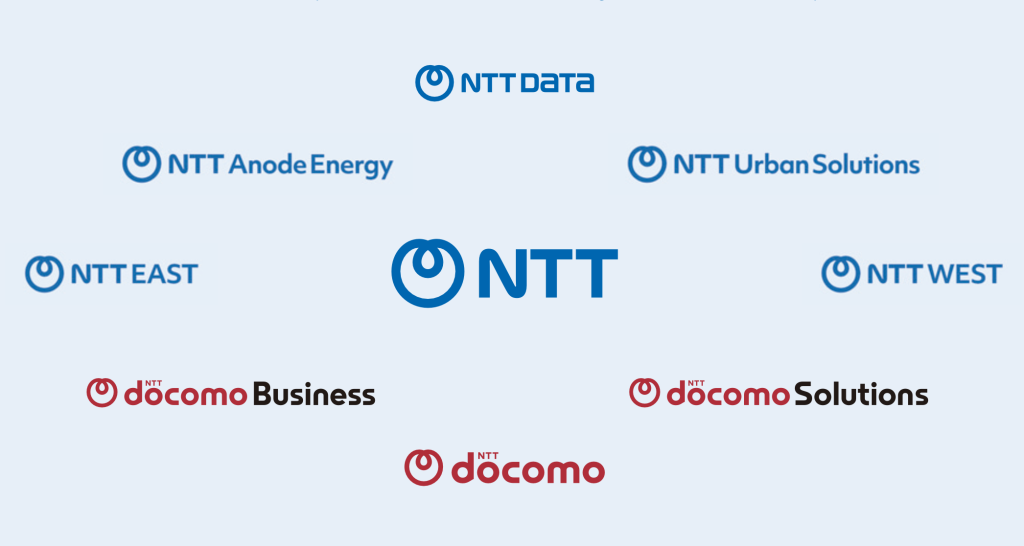
- NTT DOCOMO: Positioned for mobile and smart life services, with revenue from consumer communications and finance. Contribution through Integrated ICT ¥6,213.1 billion.
- NTT DATA: Focused on global IT solutions, data centers, AI. Revenue through Global Solutions ¥4,638.7 billion.
- NTT EAST and NTT WEST: Regional telecommunications brands for fixed-line and broadband in Japan. Combined revenue ¥3,112.3 billion.
- NTT Anode Energy: Energy brand for renewable and decarbonization solutions. Part of Other ¥1,726.5 billion.
- NTT Urban Solutions: Real estate brand for urban development. Also in Other.
- docomo Business: Enterprise solutions under DOCOMO, contributing to AI and DX services.
- docomo Solutions: Additional solutions under DOCOMO.
The dynamic loop brand symbol represents NTT’s infinite continuous loop for dynamism and commitment to innovation, with the small inner loop for voice of people.
Brand-wise revenue is aggregated in segments, with NTT DOCOMO leading in consumer, NTT DATA in global IT.
Geographical presence and region-wise revenue %
NTT Group has a strong presence in Japan and global operations in over 190 countries.
- Japan: Main headquarters in Tokyo, with regional offices, manufacturing, data centers. Revenue primarily from domestic operations across all segments.
- North America: Data centers, IT services, with 380 MW capacity added in FY2024.
- EMEA: Global solutions, offices in London.
- APAC: Operations in Singapore, India, Malaysia, Indonesia.
- Other regions: Submarine cables, global networks.
Region-wise revenue: Overseas operating revenue ¥4,638.7 billion from Global Solutions, representing global footprint. Domestic revenue dominates Integrated ICT and Regional.
Operational footprint includes data centers in Americas 982 MW, EMEA 659 MW, India 503 MW, APAC 378 MW, Japan 378 MW planned.
Manufacturing and offices in Tokyo, Osaka, and global locations for R&D and services.
Revenue contribution from overseas is increasing, with overseas operating profit ¥323.9 billion.
Financial performance analysis
NTT Group’s consolidated financial performance shows operating revenue of ¥13,704.7 billion in FY2024, operating profit ¥1,649.6 billion, profit before tax ¥1,564.7 billion, profit attributable to the company ¥1,000.0 billion.
Multi-year trend: Operating revenue from FY2020 ¥11,944.0 billion to FY2024 ¥13,704.7 billion, increasing 14.7%. Operating profit from FY2020 ¥1,671.4 billion to FY2024 ¥1,649.6 billion, slight decrease. Profit attributable from FY2020 ¥916.2 billion to FY2024 ¥1,000.0 billion, up 9.1%.
Standalone performance not separately disclosed, as consolidated includes all.
These numbers reflect business expansion in global solutions and integrated ICT, despite challenges in regional communications.
Profit and loss analysis
Revenue: ¥13,704.7 billion in FY2024, up from ¥13,374.6 billion in FY2023.
Operating profit: ¥1,649.6 billion, down from ¥1,922.9 billion, margin 12.0%.
Net profit: ¥1,000.0 billion, down from ¥1,279.5 billion.
Expense structure: Operating expenses include depreciation ¥1,722.0 billion, R&D ¥268.7 billion.
Margin movements: Operating margin from 14.4% in FY2023 to 12.0% in FY2024, due to increased expenses.
Financial ratios: ROE 10.0%, ROA 5.2%, ROIC 5.4%.
Balance sheet analysis
Assets: Total assets ¥30,062.5 billion, up from ¥29,604.2 billion.
Liabilities: Interest-bearing debt ¥10,010.1 billion, up from ¥9,591.0 billion.
Equity: Shareholders’ equity ¥10,221.6 billion, up from ¥10,159.4 billion.
Capital structure: Debt-to-equity 97.9%.
Net worth and reserves: Equity strength supports operations.
Debt and liquidity position: Strong with free cash flow ¥171.6 billion.
Cash flow analysis
Operating cash flow: ¥2,171.2 billion, down from ¥2,567.0 billion.
Investing cash flow: -¥1,999.6 billion, up in magnitude from -¥1,989.2 billion.
Financing cash flow: Includes dividends ¥433.3 billion, buybacks ¥200.0 billion.
Free cash flow: ¥171.6 billion, down from ¥577.7 billion.
These flows indicate investment in growth areas like capex ¥2,087.4 billion.
Board of directors and leadership team
The Board of Directors includes:
- Jun Sawada: Member of the Board Chairman
- Akira Shimada: Representative Member of the Board President and CEO
- Takashi Hiroi: Representative Member of the Board Senior Executive Vice President and CFO
- Riaki Hoshino: Representative Member of the Board Senior Executive Vice President and CTO
- Sachiko Oonishi: Executive Member of the Board Executive Vice President, CXO and Co-CAIO
- Patrizio Mapelli: Member of the Board
- Ken Sakamura: Outside Independent Member of the Board
- Yukako Uchinaga: Outside Independent Member of the Board
- Koichiro Watanabe: Outside Independent Member of the Board
- Noriko Endo: Outside Independent Member of the Board
- Natsuko Takei: Outside Independent Member of the Board
- Keiichiro Yanagi: Member of the Board Full-time Audit and Supervisory Committee Member
- Kanae Takahashi: Member of the Board Full-time Audit and Supervisory Committee Member
- Kensuke Koshiyama: Outside Independent Member of the Board Full-time Audit and Supervisory Committee Member
- Hideki Kanda: Outside Independent Member of the Board Audit and Supervisory Committee Member
- Kaoru Kashima: Outside Independent Member of the Board Audit and Supervisory Committee Member
Board composition: 16 members, 50% outside independent.
Executive leadership roles: President CEO oversees overall, CFO finance, CTO technology, CXO customer experience.
Committees: Nomination, Compensation, Sustainability, Audit and Supervisory.
- Nomination Committee: Policies on appointment, dismissal, candidates for board.
- Compensation Committee: Policies for compensation structure, levels.
- Sustainability Committee: Promotes sustainability initiatives.
- Audit and Supervisory Committee: Audits business execution.
Subsidiaries, associates, joint ventures and revenue %
The NTT Group has 992 consolidated subsidiaries.
- NTT DOCOMO: 100% ownership, mobile services, revenue through Integrated ICT ¥6,213.1 billion.
- NTT DATA Group: IT services, global solutions ¥4,638.7 billion.
- NTT East: Regional telecom, part of ¥3,112.3 billion.
- NTT West: Regional telecom, part of ¥3,112.3 billion.
- NTT Communications: Global communications, included in Global Solutions.
- NTT Urban Solutions: Real estate, part of Other ¥1,726.5 billion.
- NTT Anode Energy: Energy, part of Other.
- NTT Precision Medicine Corporation: Healthcare data, new.
- NTT Green & Food, Inc.: Aquaculture.
- NTT AgriTechnology Corporation: Agriculture.
- Space Compass: Space business.
- NTT Innovative Devices: Optical chips.
Associates and joint ventures include partnerships like with Toyota for mobility AI, OpenAI for AI, AALTO for HAPS.
Revenue % as per segments.
- Examples: NTT DOCOMO with 5G base stations 91,222.
- NTT DATA with 1,100 generative AI projects.
Physical properties (offices, plants, factories, etc.)
NTT Group’s physical properties include:
- Headquarters: Otemachi First Square, East Tower, Tokyo.
- Data centers: 1,741 MW in operation, with locations in Americas 982 MW, EMEA 659 MW, India 503 MW, APAC 378 MW, Japan 378 MW.
- Renewable power plants: Solar, wind, geothermal, biomass.
- Aquaculture plants: Land-based for shrimp.
- Urban developments: Urban Net Midosuji Building in Osaka.
- R&D labs: NTT IOWN Integrated Innovation Center, NTT Service Innovation Laboratory Group, NTT Science and Core Technology Laboratory Group, NTT Research Centers in Specific Fields.
- Global offices: New York, London, Singapore.
- Network facilities: Submarine cables, base stations 91,222 for 5G.
- Manufacturing: Photonic-electronic convergence devices.
List of physical properties:
- Tokyo headquarters for corporate strategy.
- Osaka for urban solutions.
- Data centers in multiple regions for cloud services.
- Power plants for renewable energy.
- Labs for R&D in Japan.
Segment-wise performance
Integrated ICT: Operating revenue ¥6,213.1 billion, up 1.2%, operating profit ¥1,020.5 billion, down 10.8%. Year-on-year: Revenue increase from enterprise and smart life, profit decrease from expenses.
Global Solutions: Revenue ¥4,638.7 billion, up 6.2%, profit ¥323.9 billion, up 4.6%. Growth from digitalization demand.
Regional Communications: Revenue ¥3,112.3 billion, down 2.2%, profit ¥295.5 billion, down 32.5%. Decline from voice services, increase in depreciation.
Other: Revenue ¥1,726.5 billion, up 5.7%, profit ¥55.8 billion, down 6.7%. Growth from data center engineering, decline from reactionary effects.
Operational performance: Integrated ICT expanded 5G base stations by 20%, average download throughput up 20% in cities. Global expanded data centers 380 MW. Regional launched FLET’S Hikari Cross Biz. Other developed renewable plants, urban buildings.
Year-on-year movements use disclosed numbers: Integrated revenue from ¥6,140.0 billion to ¥6,213.1 billion.
Founders details
The establishment of Nippon Telegraph and Telephone Corporation in 1985 was led by President Shinto, who emphasized the need to contribute to society through communications, remain humble, and earn customer trust.
Shareholding pattern
Minister of Finance: 35.28%, 29,199,372 thousand shares.
The Master Trust Bank of Japan, Ltd. (Trust Account): 11.05%, 9,142,377 thousand.
Custody Bank of Japan, Ltd. (Trust Account): 4.51%, 3,733,959 thousand.
Toyota Motor Corporation: 2.44%, 2,019,385 thousand.
State Street Bank and Trust Company 505001: 1.07%, 887,953 thousand.
State Street Bank West Client – Treaty 505234: 0.84%, 697,771 thousand.
NTT Employee Share-Holding Association: 0.75%, 618,889 thousand.
Nippon Life Insurance Company: 0.71%, 584,126 thousand.
JPMorgan Securities Japan Co., Ltd.: 0.61%, 508,035 thousand.
Moxley & Co. LLC: 0.58%, 484,094 thousand.
Promoters: Minister of Finance holds major stake.
Institutional investors: Trust banks, insurance.
Public shareholding: Remaining after major holders.
Changes: Government holds at least one-third as per NTT Act.
Parent company details if there is
NTT Corporation is the holding company, with no parent.
Investments and capital expenditure plans
Capital expenditure: ¥2,087.4 billion in FY2024.
Ongoing investments: Data centers order backlog ¥2,239.1 billion, investment plan USD 2,700 million in FY2025.
Capex allocation: Network expansion, R&D, data centers.
R&D spending: ¥268.7 billion.
Strategic priorities: IOWN commercialization, AI expansion, renewable energy.
Future strategy
The management-stated strategies focus on new value creation & sustainability 2027 powered by IOWN.
Capacity expansion: Data centers to increase MW, 5G base stations 1.2 times by March 2026.
Market focus: Global solutions, smart life, enterprise DX.
Technology and sustainability initiatives: IOWN 2.0 optical computing, tsuzumi 2 LLM, AI constellation, precision medicine, sustainable agriculture, circular economy, net zero by 2040, achieving carbon neutrality by FY2040.
Competitive landscape
Competitors named in external sources include AT&T, Verizon, Deutsche Telekom, China Mobile, Orange, Vodafone, BT Group, Telefonica, KDDI, SoftBank, Rakuten Mobile, IBM, Accenture, Wipro, Cognizant, Infosys, TCS, Capgemini, Deloitte, HCLTech.
Market positioning: NTT is positioned as a global leader in telecom and ICT, with strengths in IOWN, AI, data centers.
Key strengths
Strengths supported by data: Scale with 341,321 employees, superior technology in IOWN reducing power one-eighth, people with 43.5 training hours per employee, know-how from Expo 2025, dissemination of info.
- Extensive global presence in 190 countries.
- Robust R&D with ¥268.7 billion spend.
- Strong financials with ¥30,062.5 billion assets.
- Innovation in AI, quantum computing.
- Sustainability with GHG 2,054 ten thousand tons CO2.
- Resilience with zero critical cyber incidents.
- High employee engagement 61%.
- Customer engagement NPI 70.5, NPS -31.3.
Key challenges and risks
Risks as disclosed: ICT sector facing critical sustainability challenge with explosive growth of AI and data, power consumption 16x for data centers by 2030, 14x for power by 2030.
- Regulatory: Compliance with EU AI Act.
- Operational: Cyber risks, geopolitical.
- Financial: Debt ¥10,010.1 billion.
- Market: Competition in mobile, power consumption in IOWN.
Conclusion and strategic outlook
Based on disclosed strategy, NTT’s outlook is data-backed with targets like overseas profit margin 7.5%, ROIC 5.6% in existing areas, GHG reduction to 2,054 ten thousand tons.
Long-term positioning: As creator of new value, accelerator of sustainable society through IOWN, AI, global expansion.
