
Quick Facts / Company Snapshot
- Corporate Name: The Estée Lauder Companies Inc.
- Stock Exchange: New York Stock Exchange (Symbol: EL)
- Global Headquarters: 767 Fifth Avenue, New York, New York 10153
- Founding Year: 1946
- Founders: Estée Lauder and Joseph Lauder
- Total Net Sales (2025): $14,326 million
- Operating Loss (2025): $(785) million
- Net Loss Attributable to Company (2025): $(1,133) million
- Diluted Net Loss Per Share (2025): $(3.15)
- Gross Margin (2025): 74.0%
- Total Assets (2025): $19,892 million
- Cash and Cash Equivalents (2025): $2,921 million
- Total Equity (2025): $3,865 million
- Global Workforce: Approximately 57,000 employees
- Freestanding Stores: Approximately 1,600
- Geographic Reach: Products sold in approximately 150 countries and territories
- Voting Control: Lauder family holds approximately 84% of voting power
- Capital Expenditures (2025): $602 million
- Strategic Vision: “Beauty Reimagined”
Company Overview
The Estée Lauder Companies Inc. stands as one of the world’s preeminent manufacturers, marketers, and sellers of quality skin care, makeup, fragrance, and hair care products. Founded in 1946 by the visionary Estée Lauder and her husband Joseph Lauder, the company has evolved from a small family business into a global powerhouse acting as a steward for over 20 luxury and prestige brands. The company’s enduring reputation is built upon a foundation of innovation, sophistication, and superior quality, which has allowed it to expand its consumer reach to approximately 150 countries and territories.
- 1. Quick Facts / Company Snapshot
- 2. Company Overview
- 3. Business Segments
- 4. History and Evolution
- 5. Products and Services
- 6. Brand Portfolio
- 7. Geographical Presence
- 8. Financial Performance Analysis
- 9. Profit and Loss Analysis
- 10. Balance Sheet Analysis
- 11. Cash Flow Analysis
- 12. Board of Directors and Leadership Team
- 13. Subsidiaries, Associates, Joint Ventures
- 14. Physical Properties
- 15. Segment-wise Performance
- 16. Founders
- 17. Shareholding Pattern
- 18. Parent
- 19. Investments and Capital Expenditure Plans
- 20. Future Strategy
- 21. Competitive Landscape
- 22. Key Strengths
- 23. Key Challenges and Risks
- 24. Conclusion and Strategic Outlook
The company operates primarily as a wholesaler, distributing its diverse portfolio through a carefully cultivated network of brick-and-mortar locations and e-commerce platforms. These distribution channels include upscale department stores, specialty-multi retailers, upscale perfumeries and pharmacies, and top-tier salons and spas. A significant portion of the business is also conducted through duty-free retailers in travel retail locations such as airports and downtown stores. Complementing this wholesale model is a robust direct-to-consumer business, which engages consumers through approximately 1,600 freestanding stores and dedicated brand websites.
In February 2025, the organization embarked on a transformative strategic vision titled “Beauty Reimagined.” This forward-looking strategy focuses on accelerating best-in-class consumer coverage, creating transformative innovation, and boosting consumer-facing investments. The plan also emphasizes fueling sustainable growth through bold efficiencies and reimagining the company’s operational workflows. This strategic pivot aims to strengthen the company’s position in the highly competitive prestige beauty market and drive long-term value.
Despite being a publicly traded entity, the company retains the characteristics of a family-controlled business. Members of the Lauder family, including several who serve as directors and executive officers, beneficially own shares representing approximately 84% of the outstanding voting power. This ownership structure allows the company to maintain a long-term focus on brand stewardship and sustainable growth, even as it navigates short-term market volatilities.
Business Segments
The Estée Lauder Companies Inc. organizes its operations into four primary product categories: Skin Care, Makeup, Fragrance, and Hair Care. Each segment is responsible for the manufacturing, marketing, and sale of products that cater to specific consumer beauty needs.
Skin Care
- Segment Revenue (2025): $6,962 million
- Percentage of Total Revenue: 48.60%
- Operational Scope: This segment is the largest contributor to the company’s net sales. It encompasses a broad range of products designed to address various skin care needs, including moisturizers, serums, cleansers, toners, eye care, body care, exfoliators, acne and oil correctors, facial masks, and sun care products. The segment is anchored by major brands such as La Mer, Estée Lauder, and Clinique, which offer high-performance formulations based on dermatological research and advanced science.
Makeup
- Segment Revenue (2025): $4,205 million
- Percentage of Total Revenue: 29.35%
- Operational Scope: The makeup segment offers an extensive array of products across a wide spectrum of shades and colors. Products in this category include foundations, powders, concealers, setting sprays, lipsticks, lip liners, lip glosses, mascaras, eyeshadows, and eyeliners. The segment also markets related items such as compacts, brushes, and other makeup tools. Key brands driving this segment include M·A·C, Bobbi Brown Cosmetics, and Too Faced, which cater to both professional artistry and everyday consumer needs.
Fragrance
- Segment Revenue (2025): $2,491 million
- Percentage of Total Revenue: 17.39%
- Operational Scope: This segment includes a variety of fragrance products sold in various forms, such as parfum, eau de parfum, eau de toilette, eau de cologne, and body spray. Additionally, the segment includes lotions, creams, powders, candles, and soaps that are based on particular fragrances. The company’s luxury and artisanal fragrance portfolio includes brands like Jo Malone London, TOM FORD, Le Labo, and KILIAN PARIS, which focus on craftsmanship and sensory experiences.
Hair Care
- Segment Revenue (2025): $565 million
- Percentage of Total Revenue: 3.94%
- Operational Scope: The hair care segment offers high-performance products including shampoos, conditioners, styling products, treatment, finishing sprays, and hair color products. This segment is primarily driven by the Aveda and Bumble and bumble brands, which are distributed through top-tier salons, specialty retailers, and freestanding stores.
Other
- Segment Revenue (2025): $100 million
- Percentage of Total Revenue: 0.70%
- Operational Scope: This category includes royalty revenue derived from the licensing of the TOM FORD trademark to third parties, following the company’s acquisition of the brand in fiscal 2023. It also includes sales from ancillary products and services that do not fit within the primary product categories.
History and Evolution
The Estée Lauder Companies Inc. has a rich history dating back to its founding in 1946 by Estée and Joseph Lauder. From its humble beginnings with just four skin care products, the company has grown into a global phenomenon through a combination of organic brand building and strategic acquisitions.
- 1946: The company was founded by Estée and Joseph Lauder, launching the Estée Lauder brand in the United States with a focus on high-quality skin care.
- 1964: The company pioneered the prestige men’s fragrance and grooming market with the introduction of Aramis.
- 1968: Clinique was introduced as the first allergy-tested, 100% fragrance-free dermatological brand, expanding the company’s reach into clinical skin care.
- 1987: Lab Series was launched, offering high-performance skincare solutions specifically for men.
- 1990: Origins was introduced, focusing on natural skin care powered by nature and proven by science.
- 1994-1998: The company acquired a majority interest in M·A·C in 1994 and completed the acquisition in 1998, establishing a stronghold in professional makeup.
- 1995: Strategic acquisitions of Bobbi Brown Cosmetics and La Mer brought prestige makeup and luxury skincare into the portfolio.
- 1997: Aveda was acquired, adding high-performance, botanical hair care and a commitment to sustainability.
- 1999: Jo Malone London was acquired, expanding the company’s presence in the British luxury lifestyle and fragrance market.
- 2000-2006: The company acquired a majority interest in Bumble and bumble in 2000 and completed the acquisition in 2006, strengthening its hair care portfolio.
- 2003: Darphin, a Paris-based prestige skin care brand, was acquired.
- 2005: The company entered into a license agreement to develop and distribute beauty products under the TOM FORD brand name.
- 2010: Smashbox Cosmetics was acquired, bringing a photo studio-inspired makeup brand into the fold.
- 2012: AERIN Beauty was launched as a luxury lifestyle beauty and fragrance brand.
- 2014: Le Labo, a sensory lifestyle brand rooted in slow perfumery, was acquired.
- 2015: The acquisitions of Editions de Parfums Frédéric Malle and GLAMGLOW further diversified the fragrance and skin care offerings.
- 2016: KILIAN PARIS and Too Faced were acquired, adding ultra-luxury fragrance and playful prestige makeup to the portfolio.
- 2019: Dr.Jart+, a Seoul-based global skin care brand, was acquired, enhancing the company’s presence in the Asian beauty market.
- 2021-2024: The company increased its investment in DECIEM (owner of The Ordinary) to 76% in 2021 and purchased the remaining interest in 2024.
- 2022: BALMAIN Beauty was established through a license from the fashion house Balmain Paris.
- 2023: The company completed the acquisition of the TOM FORD brand and related intellectual property, securing ownership of the luxury brand.
Products and Services
The company’s product portfolio is vast, catering to a wide range of consumer preferences across different categories.
Skin Care Products
- Revenue (2025): $6,962 million
- Percentage of Total Revenue: 48.60%
- Details: This category includes advanced formulations for anti-aging, hydration, and correction. Products include the iconic Crème de la Mer, Estée Lauder’s Advanced Night Repair serums, and Clinique’s dermatological solutions. The range covers cleansers, toners, moisturizers, serums, eye care, and sun care.
Makeup Products
- Revenue (2025): $4,205 million
- Percentage of Total Revenue: 29.35%
- Details: The makeup category offers products for the face, eyes, and lips. Key items include foundations like Estée Lauder Double Wear, M·A·C lipsticks, and Bobbi Brown concealers. The segment also includes artistry tools such as brushes and applicators.
Fragrance Products
- Revenue (2025): $2,491 million
- Percentage of Total Revenue: 17.39%
- Details: This category features prestige and luxury scents. Offerings range from Jo Malone London’s colognes to TOM FORD’s Private Blend collection and Le Labo’s artisanal perfumes. Products are sold as sprays, colognes, and home fragrance items like candles and diffusers.
Hair Care Products
- Revenue (2025): $565 million
- Percentage of Total Revenue: 3.94%
- Details: Hair care products focus on premium care and styling. Aveda offers plant-based shampoos, conditioners, and treatments, while Bumble and bumble provides salon-quality styling products and hairsprays.
Brand Portfolio
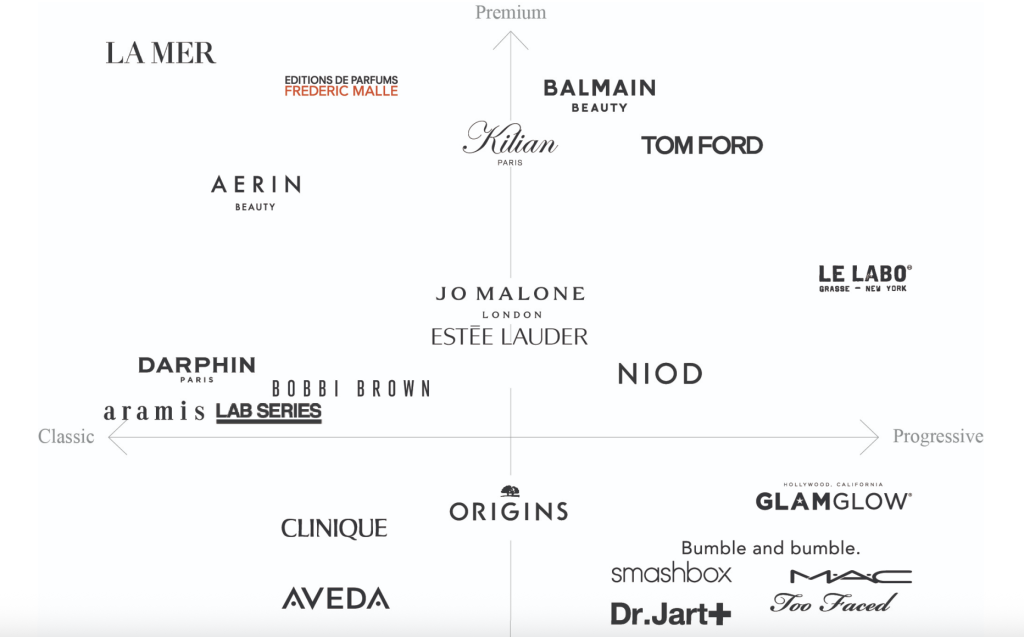
The company manages a portfolio of over 20 distinct brands, categorized by their positioning and scale within the market.
Luxury Brands
- La Mer: A top-tier luxury skin care brand known for its “Miracle Broth.”
- Jo Malone London: A British lifestyle brand famous for its unique fragrance portfolio.
- TOM FORD: A comprehensive luxury brand spanning fragrance, makeup, and skin care.
- Le Labo: An artisanal fragrance brand offering personalized experiences.
- KILIAN PARIS: A sophisticated prestige fragrance brand.
- Editions de Parfums Frédéric Malle: An exclusive collection of fragrances crafted by master perfumers.
- AERIN Beauty: A luxury lifestyle beauty brand inspired by Aerin Lauder.
- BALMAIN Beauty: A new luxury beauty brand established in 2022.
Large Brands
- Estée Lauder: The flagship brand representing the height of sophistication and quality.
- Clinique: A leading dermatological brand offering allergy-tested products.
- M·A·C: The world’s leading professional makeup authority.
- La Mer: (Also categorized as a Luxury Brand).
Scaling Brands
- The Ordinary: An evolving collection of treatments offering familiar, effective clinical technologies.
- Aveda: A pioneer in botanical hair and skin care with a focus on sustainability.
- Bobbi Brown Cosmetics: A brand dedicated to enhancing individual beauty through makeup and skin care.
- Jo Malone London: (Also categorized as a Luxury Brand).
- TOM FORD: (Also categorized as a Luxury Brand).
Developing Brands
- Dr.Jart+: A global skin care brand blending art and dermatological science.
- Too Faced: A playful makeup brand known for innovative formulas and packaging.
- Origins: A brand offering high-performance natural skin care.
- Smashbox: A photo studio-inspired makeup brand based in Los Angeles.
- Bumble and bumble: A dedicated hair care brand born from a New York salon.
- Darphin Paris: A Parisian skincare brand utilizing botanical ingredients.
- Lab Series: A brand exclusively dedicated to men’s skincare needs.
- GLAMGLOW: A Hollywood-inspired skin care brand known for its masks.
- NIOD: A brand focused on non-invasive options in dermal science.
- Aramis: A classic brand in men’s fragrance and grooming.
Geographical Presence
The company’s global footprint is divided into three major reporting regions for fiscal 2025, with a planned reorganization for fiscal 2026.
Europe, the Middle East & Africa (EMEA)
- Region Revenue (2025): $5,375 million
- Percentage of Total Revenue: 37.52%
- Operational Scope: This region is the largest by revenue and includes the company’s substantial global travel retail business. Key markets include the United Kingdom, France, and emerging markets in the Middle East and Africa. Net sales in this region decreased by 12% in fiscal 2025, primarily due to challenges in the travel retail sector.
Asia/Pacific
- Region Revenue (2025): $4,537 million
- Percentage of Total Revenue: 31.67%
- Operational Scope: This region encompasses key markets such as mainland China, Japan, Korea, Hong Kong SAR, and Australia. The company maintains a strong presence here, particularly in skin care and luxury fragrance. Net sales decreased by 7% in fiscal 2025, influenced by a challenging retail environment in mainland China.
The Americas
- Region Revenue (2025): $4,411 million
- Percentage of Total Revenue: 30.81%
- Operational Scope: This region includes North America (United States and Canada) and Latin America. It serves as the home market for many of the company’s brands. Net sales in The Americas decreased by 4% in fiscal 2025.
Note on Regional Reorganization: Beginning in fiscal 2026, the company will report under four new regions: The Americas; Europe, the United Kingdom and Ireland and Emerging Markets (EUKEM); Asia/Pacific (including global travel retail); and Mainland China as a standalone region.
Financial Performance Analysis
Fiscal 2025 was a challenging year for The Estée Lauder Companies Inc., marked by a contraction in sales and profitability due to various macroeconomic and operational headwinds.
- Consolidated Net Sales:
- 2025: $14,326 million
- 2024: $15,608 million
- 2023: $15,910 million
- Trend: Net sales declined by 8% year-over-year in 2025 and have been on a downward trend since 2023.
- Operating Income/Loss:
- 2025: $(785) million (Loss)
- 2024: $970 million (Income)
- 2023: $1,509 million (Income)
- Trend: The company swung to a significant operating loss in 2025, driven by impairment charges and sales declines.
- Net Earnings/Loss:
- 2025: $(1,133) million (Loss)
- 2024: $390 million (Income)
- 2023: $1,006 million (Income)
- Trend: Net earnings dropped precipitously, resulting in a net loss of over $1.1 billion in 2025.
Profit and Loss Analysis
- Net Sales: $14,326 million
- Cost of Sales: $3,729 million
- Gross Profit: $10,597 million
- Gross Margin: 74.0% (Increased from 71.7% in 2024)
- Operating Expenses:
- Selling, General and Administrative: $9,456 million
- Restructuring and Other Charges: $481 million
- Impairment of Other Intangible Assets: $1,273 million
- Goodwill Impairment: $13 million
- Talcum Litigation Settlement Agreements: $159 million
- Total Operating Expenses: $11,382 million
- Operating Loss: $(785) million
- Operating Margin: (5.5)%
- Interest Expense: $357 million
- Interest Income: $114 million
- Provision for Income Taxes: $93 million
- Net Loss Attributable to The Estée Lauder Companies Inc.: $(1,133) million
Balance Sheet Analysis
The company’s balance sheet reflects significant assets but also the impact of recent financial challenges and strategic acquisitions.
- Total Assets: $19,892 million
- Current Assets: $7,069 million, including $2,921 million in cash and cash equivalents and $2,074 million in inventory.
- Noncurrent Assets: Includes $3,172 million in property, plant, and equipment, $2,135 million in goodwill, and $3,759 million in other intangible assets.
- Total Liabilities: $16,027 million (Calculated: Total Assets $19,892m – Total Equity $3,865m)
- Current Liabilities: $5,435 million, including $3,529 million in other accrued liabilities and $1,497 million in accounts payable.
- Noncurrent Liabilities: $10,592 million, including $7,314 million in long-term debt and $1,744 million in long-term operating lease liabilities.
- Total Equity: $3,865 million
- Retained Earnings: $11,672 million.
- Treasury Stock: $(13,698) million.
- Accumulated Other Comprehensive Loss: $(1,127) million.
Cash Flow Analysis
Despite the net loss, the company generated positive operating cash flow, although it was lower than in previous years.
- Net Cash Flows Provided by Operating Activities: $1,272 million. Key adjustments included $1,286 million for impairment of goodwill and other intangible assets and $829 million for depreciation and amortization.
- Net Cash Flows Used for Investing Activities: $(623) million. This included $602 million in capital expenditures.
- Net Cash Flows Used for Financing Activities: $(1,144) million. Major outflows included $618 million for dividends paid to stockholders and $505 million for repayments of long-term debt.
- Net Change in Cash and Cash Equivalents: A decrease of $474 million for the year.
Board of Directors and Leadership Team
The leadership team comprises experienced executives and a board with deep industry knowledge, heavily influenced by the founding family.
Executive Officers (As of August 13, 2025)
- Stéphane de La Faverie (51): President, Chief Executive Officer and a Director.
- Akhil Shrivastava (52): Executive Vice President and Chief Financial Officer.
- William P. Lauder: Chair of the Board.
- Jane Hertzmark Hudis (65): Executive Vice President, Chief Brand Officer.
- Roberto Canevari (59): Executive Vice President, Chief Value Chain Officer.
- Michael Bowes (54): Executive Vice President, Chief People Officer.
- Rashida La Lande (51): Executive Vice President and General Counsel.
- Meridith Webster (49): Executive Vice President, Global Communications and Public Affairs.
- Ronald S. Lauder (81): Chairman of Clinique Laboratories, LLC.
Board of Directors
- William P. Lauder: Chair of the Board.
- Stéphane de La Faverie: President and CEO.
- Charlene Barshefsky: Chair, Parkside Global Advisors.
- Angela Wei Dong: Chairman and CEO of NIKE Greater China.
- Lynn Forester de Rothschild: Chief Executive Officer and Chair E.L. Rothschild LLC.
- Paul J. Fribourg: Chairman and CEO, Continental Grain Company.
- Jennifer Hyman: Co-Founder, CEO, and Chair, Rent the Runway, Inc.
- Gary M. Lauder: Managing Director, Lauder Partners LLC.
- Jane Lauder: Director.
- Arturo Nuñez: Director.
- Barry S. Sternlicht: Director.
- Jennifer Tejada: Director.
- Richard F. Zannino: Director.
- Eric L. Zinterhofer: Director.
Subsidiaries, Associates, Joint Ventures
The company operates through numerous wholly-owned subsidiaries. Key significant subsidiaries include:
- Estee Lauder Inc.: Incorporated in Delaware.
- ELC Management LLC: Incorporated in Delaware.
- 001 DEL LLC: Incorporated in Delaware.
- Too Faced Cosmetics, LLC: Incorporated in Delaware.
- Estee Lauder (Shanghai) Commercial Company Ltd.: Organized in China.
- Estee Lauder AG Lachen: Organized in Switzerland.
- Have&Be Co. Ltd.: Organized in Korea (parent of Dr.Jart+).
- Deciem Beauty Group Inc.: Organized in Canada (parent of The Ordinary and NIOD).
Physical Properties
The company maintains a vast global network of facilities to support its manufacturing, R&D, and retail operations.
- Freestanding Stores: The company operates approximately 1,600 freestanding stores worldwide.
- Long-Lived Assets (Property, Plant, Equipment & ROU Assets):
- United States: $1,956 million.
- Japan: $780 million.
- All Other Countries: $2,388 million.
- Total Long-Lived Assets: $5,124 million.
- Facilities: The company owns and leases various manufacturing, assembly, research and development, and distribution facilities across the globe to support its operations.
Segment-wise Performance
Skin Care Performance (2025)
- Revenue Change: Decrease of 12% to $6,962 million.
- Operating Income: $574 million, a decrease of 22% from the prior year.
- Drivers: The decline was primarily driven by lower net sales from the Estée Lauder and La Mer brands, particularly in mainland China and travel retail.
Makeup Performance (2025)
- Revenue Change: Decrease of 6% to $4,205 million.
- Operating Loss: $(441) million, a steep decline from operating income of $93 million in 2024.
- Drivers: The decrease in sales was driven by lower volumes, while the operating loss was significantly impacted by impairment charges related to the Dr.Jart+ and Too Faced reporting units.
Fragrance Performance (2025)
- Revenue Change: Increase of 0% (Flat) at $2,491 million.
- Operating Loss: $(378) million, compared to income of $265 million in 2024.
- Drivers: Sales were flat as growth in Le Labo and KILIAN PARIS offset declines in other brands. The operating loss was primarily due to a $549 million impairment charge related to the TOM FORD trademark.
Hair Care Performance (2025)
- Revenue Change: Decrease of 10% to $565 million.
- Operating Loss: $(41) million, an improvement from a loss of $(52) million in 2024.
- Drivers: The sales decline reflected weakness in the segment, although operating losses narrowed slightly.
Founders
The company was founded in 1946 by Estée Lauder and her husband, Joseph Lauder. Estée Lauder was a visionary entrepreneur who formulated the company’s unique marketing philosophy of “High-Touch” service, believing in the importance of connecting directly with consumers. Joseph Lauder oversaw the financial and operational aspects of the business. Their legacy continues to influence the company’s culture and strategic direction.
Shareholding Pattern
The Estée Lauder Companies Inc. has a dual-class share structure that concentrates control within the founding family.
- Class A Common Stock: Publicly traded on the NYSE (Symbol: EL). One vote per share.
- Class B Common Stock: Not publicly traded. Ten votes per share. Owned principally by members of the Lauder family.
- Lauder Family Control: Members of the Lauder family beneficially own shares of Class A and Class B Common Stock having approximately 84% of the outstanding voting power of the company.
- Outstanding Shares (August 13, 2025): 234,347,415 shares of Class A Common Stock and 125,542,029 shares of Class B Common Stock.
Parent
The Estée Lauder Companies Inc. is the ultimate parent entity of the group. There is no other parent company above it. The company is, however, a “controlled company” due to the voting power held by the Lauder family.
Investments and Capital Expenditure Plans
The company continues to invest in its future growth through capital expenditures and strategic initiatives.
- Capital Expenditures (2025): $602 million was invested in capital projects.
- Strategic Investments: The company makes minority investments in beauty companies through its New Incubation Ventures arm to tap into emerging trends and brands.
- R&D and Innovation: Investments are focused on creating transformative innovation and boosting consumer-facing activities as part of the “Beauty Reimagined” strategy.
- Profit Recovery and Growth Plan: The company is executing a restructuring program to improve gross margins and reduce the cost base, which involves investments in organizational rightsizing and process simplification.
Future Strategy
The company’s future is guided by its “Beauty Reimagined” vision and the Profit Recovery and Growth Plan (PRGP).
- Expansion & Focus: The strategy focuses on accelerating best-in-class consumer coverage, creating transformative innovation, and boosting consumer-facing investments.
- Regional Reorganization: Starting fiscal 2026, the company will reorganize its reporting into four regions—The Americas, EUKEM, Asia/Pacific, and Mainland China—to enhance accountability and streamline operations.
- Operational Efficiency: The PRGP aims to rebuild stronger, sustainable profitability by improving gross margins, lowering the cost base, and reducing overhead expenses to drive operating leverage.
- Digital Transformation: Continued investment in online channels and digital capabilities to reach consumers globally.
Competitive Landscape
The beauty business is described as highly competitive. The company faces vigorous competition from companies throughout the world, including multinational consumer product companies. The company competes on factors such as brand recognition, product quality, performance, price, packaging, and service. While specific competitor names are not listed in the report as peers, the company acknowledges the intense competition in the prestige beauty sector.
Key Strengths
- Prestige Brand Portfolio: A diversified portfolio of over 20 distinctive brands across four major categories, including global giants like Estée Lauder and La Mer.
- Global Reach: A balanced presence in developed and emerging markets, with sales in approximately 150 countries.
- High-Touch Service: A unique marketing philosophy that fosters strong consumer loyalty through personalized experiences.
- Innovation: A strong research and development capability that drives product innovation and trend leadership.
- Gross Margin: A robust gross margin of 74.0% in fiscal 2025, indicating strong pricing power and manufacturing efficiency.
Key Challenges and Risks
- Market Volatility: The company is subject to volatility in the global prestige beauty market, particularly in key regions like mainland China and travel retail.
- Financial Performance: Fiscal 2025 saw a net loss and declining sales, highlighting the need for successful execution of recovery plans.
- Impairment Charges: Significant impairment charges related to brands like TOM FORD, Dr.Jart+, and Too Faced have impacted profitability.
- Regulatory Environment: The company is subject to complex and evolving government regulations worldwide, including those related to ingredients, packaging, and environmental matters.
- Cybersecurity: Risks related to information technology and potential cybersecurity incidents that could disrupt operations.
- Competition: Intense competition from other multinational players requires constant investment and innovation.
Conclusion and Strategic Outlook
The Estée Lauder Companies Inc. remains a titan in the global beauty industry, possessing an enviable portfolio of brands and a vast global infrastructure. However, fiscal 2025 was a year of recalibration, evidenced by a decline in sales and a net loss driven by significant impairment charges. The company’s response—the “Beauty Reimagined” strategy and the Profit Recovery and Growth Plan—demonstrates a proactive approach to addressing these challenges.
By reorganizing its geographic reporting structure and focusing on operational efficiencies, the company aims to restore sustainable profitable growth. The continued control by the Lauder family ensures a long-term perspective on brand building. As the company executes its strategic initiatives in fiscal 2026 and beyond, its success will depend on its ability to reinvigorate sales growth in key markets like China and travel retail, while effectively managing costs and leveraging its high-gross-margin business model.
Official Site: https://www.elcompanies.com
FAQ Section:
- What was The Estée Lauder Companies Inc.’s revenue in fiscal 2025? The company reported total net sales of $14,326 million for the fiscal year ended June 30, 2025.
- What are the main business segments of The Estée Lauder Companies Inc.? The company operates in four primary segments: Skin Care ($6.96 billion), Makeup ($4.21 billion), Fragrance ($2.49 billion), and Hair Care ($565 million).
- Is The Estée Lauder Companies Inc. profitable? In fiscal year 2025, the company reported a net loss attributable to the company of $(1,133) million, compared to net earnings in the previous year.
- Who controls The Estée Lauder Companies Inc.? The company is a “controlled company” with the Lauder family holding approximately 84% of the outstanding voting power.
- What is the “Beauty Reimagined” strategy? It is a strategic vision launched in February 2025 focused on accelerating consumer coverage, innovation, investment, and sustainable growth through efficiencies.
- Does The Estée Lauder Companies Inc. own the TOM FORD brand? Yes, the company acquired the TOM FORD brand and related intellectual property in fiscal 2023.
- How many countries does The Estée Lauder Companies Inc. operate in? The company sells its products in approximately 150 countries and territories worldwide.
- What was the gross margin for The Estée Lauder Companies Inc. in 2025? The company achieved a gross margin of 74.0% in fiscal year 2025.
